
Redoing a root canal
Root canal retreatment for a treated tooth that never settled
Root canal retreatment is the revision of a tooth that was root treated before and did not settle. The old root filling is removed, the canal system is re-cleaned and disinfected under the microscope, then sealed again. In many cases that resolves the infection without surgery, and the tooth is kept.
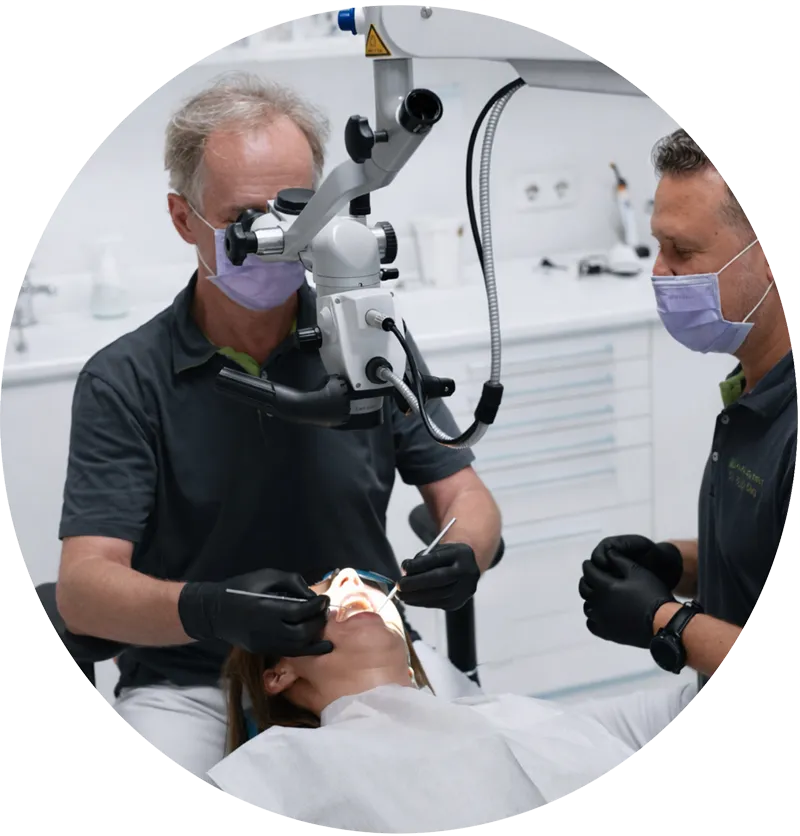
Reopening a treated tooth under magnification
- Covers
- Revision, fractured files
- Method
- 25× microscope, isolated field
- Assessment
- Panoramic X-ray or 3D CT
- Anaesthetic
- Local
- Review
- X-rays over 6–12 months
- Price
- Personal quote at your free consultation
What retreatment can put right
A root canal fails for a reason, and the reason is usually mechanical: part of the canal system was never cleaned, or the seal let bacteria back in. Retreatment goes after that reason rather than the symptom.
The canal nobody found
A canal that was missed at the first attempt stays infected under the filling. Magnification makes it possible to open canals that cannot be seen with the naked eye, and in some cases cannot be seen on an X-ray either. This is the single most common thing we find when reopening a treated tooth.
A fractured instrument retrieved
A file broken off inside a canal during an earlier treatment blocks everything below it. Under the microscope the fragment can often be located and removed rather than left in place and sealed over, which reopens the rest of the canal to cleaning.
Inflammation in the bone around the root tip
Where infection has persisted in the canal, the bone at the root tip can react, and an area of inflammation forms in it. When the canal system is the source, cleaning, disinfecting and sealing it properly takes away what is feeding that inflammation, and in many cases the bone repairs itself over the following months with no surgery at all. Whether that is happening is judged on follow-up X-rays, not promised in advance.
Surgery is not the automatic next step
A failed root canal is often revisable from above, through the crown of the tooth, before anyone opens the gum. That is why retreatment is assessed first here. Some teeth still need surgery at the root tip, and some cannot be kept at all, but that decision belongs after the non-surgical option has been looked at rather than before.
A seal that runs to the tip again
The old filling material is taken out along the full length of each canal, the canal is re-measured, and a hermetic wall-adhering seal is placed all the way to the root tip. A short or leaking root filling is a route back in for bacteria, and it is one of the failures retreatment is designed to correct.
An honest answer about the tooth
Not every treated tooth is worth revising. If too little sound structure is left, if the root is fractured, or if the tooth cannot carry a restoration afterwards, we say so at the assessment and talk about replacing it instead. You are told which of those you are looking at before anything is booked.
Retreatment is worth assessing when
- a tooth treated elsewhere still aches, throbs or is tender to bite on
- a swelling or a small gum boil keeps coming back over a root-treated tooth
- an X-ray shows a dark area in the bone around the root tip of a treated tooth
- an instrument was left in a canal during an earlier treatment
- a root-treated tooth has never felt right since the day it was done
- a crown or a bridge is planned over a tooth whose old root filling looks incomplete
The appointment
How a tooth is retreated
Retreatment is the first root canal plus the work of undoing the first one, so it usually takes longer per canal. How many visits it needs depends on what comes out of the tooth and how the inflammation responds, and we tell you that after the examination rather than at the end.
- 01
Examination and imaging
The tooth is examined and imaged. A dark area around a root tip on an X-ray is not a diagnosis on its own, so it is read together with the clinical findings, and a 3D CT scan is used where a panoramic X-ray cannot settle the question. Bring any images from the clinic that treated you.
- 02
Deciding whether the tooth is restorable
Before anything is reopened we look at what would hold a restoration afterwards. A tooth with a fractured root, or with too little sound structure left above the gum, is not made better by retreating the canal, and we say that at this point.
- 03
Local anaesthetic and isolation
The tooth and the tissue around it are anaesthetised locally, then the tooth is isolated with a dedicated isolation device so that saliva and bacteria stay out of the field. Keeping the canal clean while it is open matters as much as the mechanical work of clearing it.
- 04
Removing the old root filling
The existing filling material is taken out of each canal along its whole length, together with any post or core material in the way. This is the step that separates retreatment from a first root canal, and it is where magnification earns its place.
- 05
Finding what was missed
With the canals cleared, the floor of the pulp chamber is examined at twenty-five times its size for the canal that was not treated, for a fractured instrument, or for a crack that explains why the tooth never settled.
- 06
Cleaning, disinfecting, sealing
Each canal is measured to its full working length, cleaned and disinfected along that length, then sealed with a hermetic wall-adhering filling that runs to the root tip. Where the inflammation needs it, the canal is dressed and left to settle before the final seal goes in.
- 07
Rebuilding, then reviewing on X-ray
The tooth is restored according to how much of it is left, with tooth-coloured filling material, with a post set into the root, or with a crown. Healing at the root tip is then assessed on follow-up X-rays over a period of months, typically reviewed between six and twelve months after the treatment, because bone repairs slowly and there is nothing to see earlier.
If the tooth stays inflamed after retreatment, or if the canal system cannot be reached from above, surgery at the root tip is the next option: the tip of the root and the infected tissue around it are removed through the gum, and the canal is sealed from below. Where neither route can save the tooth, extraction and a planned replacement is the honest answer, and we will tell you if that is where your case is heading.
Three routes for a failed root canal
Retreatment, surgery or replacement
These are the three options actually on the table for a root-treated tooth that has not settled. Which one applies is decided at the assessment, from the imaging and from what is left of the tooth.
What happens to the tooth
- Retreatment, no surgery
- Kept. It is reopened through the crown, cleaned and sealed again
- Root tip surgery
- Kept, with the root tip removed and the canal sealed from below
- Extraction and implant
- Removed, and the gap restored with an implant, a bridge or a denture
How it is reached
- Retreatment, no surgery
- Through the biting surface, no incision in the gum
- Root tip surgery
- Through a small incision in the gum, working on the bone at the root tip
- Extraction and implant
- Through the socket, with the gum closed over it afterwards
Anaesthetic
- Retreatment, no surgery
- Local
- Root tip surgery
- Local
- Extraction and implant
- Local
Healing
- Retreatment, no surgery
- No surgical wound. Where the bone has been damaged by inflammation, it repairs over months in many cases
- Root tip surgery
- A surgical site that heals over days, with the bone defect filling in more slowly
- Extraction and implant
- The socket heals over weeks, and the bone continues to resorb where the root used to be
Follow-up
- Retreatment, no surgery
- X-ray review over months, usually between six and twelve
- Root tip surgery
- Sutures out at around 7–10 days, then X-ray review
- Extraction and implant
- Review of the site, then planning and placement of the replacement
What decides suitability
- Retreatment, no surgery
- Whether the canal system can be reached and cleaned, and whether enough sound tooth remains to restore
- Root tip surgery
- Retreatment not possible or already tried, and the root otherwise sound
- Extraction and implant
- A fractured root, too little tooth left to restore, or infection that neither route resolves
None of these is a default. A tooth that can be retreated non-surgically is usually retreated first, because it keeps the most options open, but surgery and extraction are the right answer in some cases and we will say so plainly rather than talk you into keeping a tooth that cannot be kept.
What it costs
What retreatment costs here
Retreatment is quoted per tooth after the examination, and it sits above a first root canal on the same tooth because the old filling has to come out before the real work starts.
What decides the figure
- Which tooth it is
- A front tooth with one canal and a molar with four are different amounts of work, both to clear and to re-seal.
- What is in the canals
- Old filling material, a post cemented into the root, or a fractured instrument each add time to the appointment, and the imaging usually shows which apply before you are quoted.
- How many appointments it takes
- Some teeth are cleaned and sealed in one visit. Where the inflammation needs it, the canal is dressed and reviewed before the final seal, which means a second appointment.
- How the tooth is rebuilt
- A tooth-coloured build-up, a post set into the root, and a crown are separate steps with separate costs, decided by how much sound tooth is left once the old work is out.
- Imaging
- A panoramic X-ray covers many cases; a 3D scan is used where the anatomy or the extent of the inflammation calls for it. The imaging your case needs is part of the plan you are quoted for.
How you get a price
- 01Free consultationThe clinic's personal assessment costs nothing. We look at the tooth, review any imaging your case needs and explain what the options actually involve.
- 02A cost estimate before anything is scheduledYou are quoted for your own mouth, for the materials your case needs and the number of appointments it takes, rather than handed a table average that may not apply to you.
- 03You decide afterwardsThere is no obligation to book treatment after the consultation. If you are comparing clinics, take the estimate home with you.
Most of our patients travel from Austria and Germany. In the clinic's experience, treatment here costs on average 15 to 20 percent less than comparable private care in Austria. Your own figure depends on your treatment plan, and you will have it in writing before anything is booked.
The figures on this page and on the price list are indicative and show what treatment starts from. Your own amount comes from your examination and is given to you in writing before anything is booked. The examination is free.
Retreatment, answered
Can a root canal that failed be redone?
Often, yes. A root canal that did not settle can usually be reopened, the old filling material removed, the canal system re-cleaned and disinfected under the microscope, and the tooth sealed again. The usual reason for the first failure is a canal that was never found, and at 25× magnification it can frequently be located. Whether your tooth is one of those is decided at the examination, from the imaging and from how much sound tooth is left.
My X-ray shows a dark area at the root tip. Does that mean surgery?
Not necessarily, and it is not something anyone can tell you from a description. A dark area around a root tip usually means the bone has reacted to infection coming out of the canal, and it is assessed with imaging, a panoramic X-ray or a 3D CT scan where the case needs one, alongside the clinical examination. When the canal system is the source and it can be properly cleaned, disinfected and sealed, the inflammation frequently settles on its own over the following months and no bone surgery is needed. That is not a promise for an individual tooth: some cases do need root tip surgery, called an apicoectomy, and a few teeth cannot be saved at all.
An instrument broke inside my tooth during an earlier treatment. Is that fixable?
Often it is. Retrieving a file that fractured inside a canal is one of the specific things magnification makes possible: at 25× the fragment can be located and, in many cases, removed rather than sealed over in place. Where it genuinely cannot be retrieved, there are still options, including cleaning and sealing around it or treating the tooth surgically. Bring any X-rays you have from the clinic that treated you and we will tell you at the consultation what we think is realistic.
How long before we know whether the retreatment worked?
Months, not days. Symptoms usually settle within a few weeks, but bone at the root tip repairs slowly, so healing is assessed on follow-up X-rays over a period of months, typically reviewed between six and twelve months after the treatment. If the area is smaller on the review film and the tooth is comfortable, that is the picture we are looking for. If it is not, we discuss surgery or replacement at that point rather than waiting indefinitely.
Is retreatment worth it, or should the tooth just come out?
It depends on what is left of the tooth. Keeping your own tooth preserves the bone around it and avoids the longer, more expensive job of replacing it, so where the canal system can be reached and enough sound structure remains, retreatment is usually the first thing to assess. Where the root is fractured, or too little tooth remains above the gum to hold a restoration, retreating the canal does not fix the real problem and extraction with a planned replacement is the more honest route. We tell you which of those applies before you commit to anything.
I was treated in Austria. What should I bring to the consultation?
Any X-rays or 3D scans from the clinic that treated you, and whatever you were told about the tooth, including how long ago it was done. Sopron is roughly 70 kilometres from Vienna and the whole appointment can be handled in German. Retreatment often needs more than one visit, so tell us you are travelling when you book and the appointments will be planned around it.
Next step
Get a second opinion on the tooth before it comes out.
Bring the X-rays from the clinic that treated you. We examine the tooth, image it if the case needs it, and tell you honestly whether retreatment is realistic. The assessment costs nothing.
Or call the clinic+36 (99) 50 60 90