
Replacing missing teeth
Dentures in Sopron, Hungary: full, partial and combined tooth replacement
A denture replaces missing teeth with a plate of false teeth that you take out to clean. The clinic makes full dentures for a jaw with no teeth left, partial dentures held by clasps on your own remaining teeth, and combined work, where a fixed crown or bridge holds the removable part by a hidden attachment.
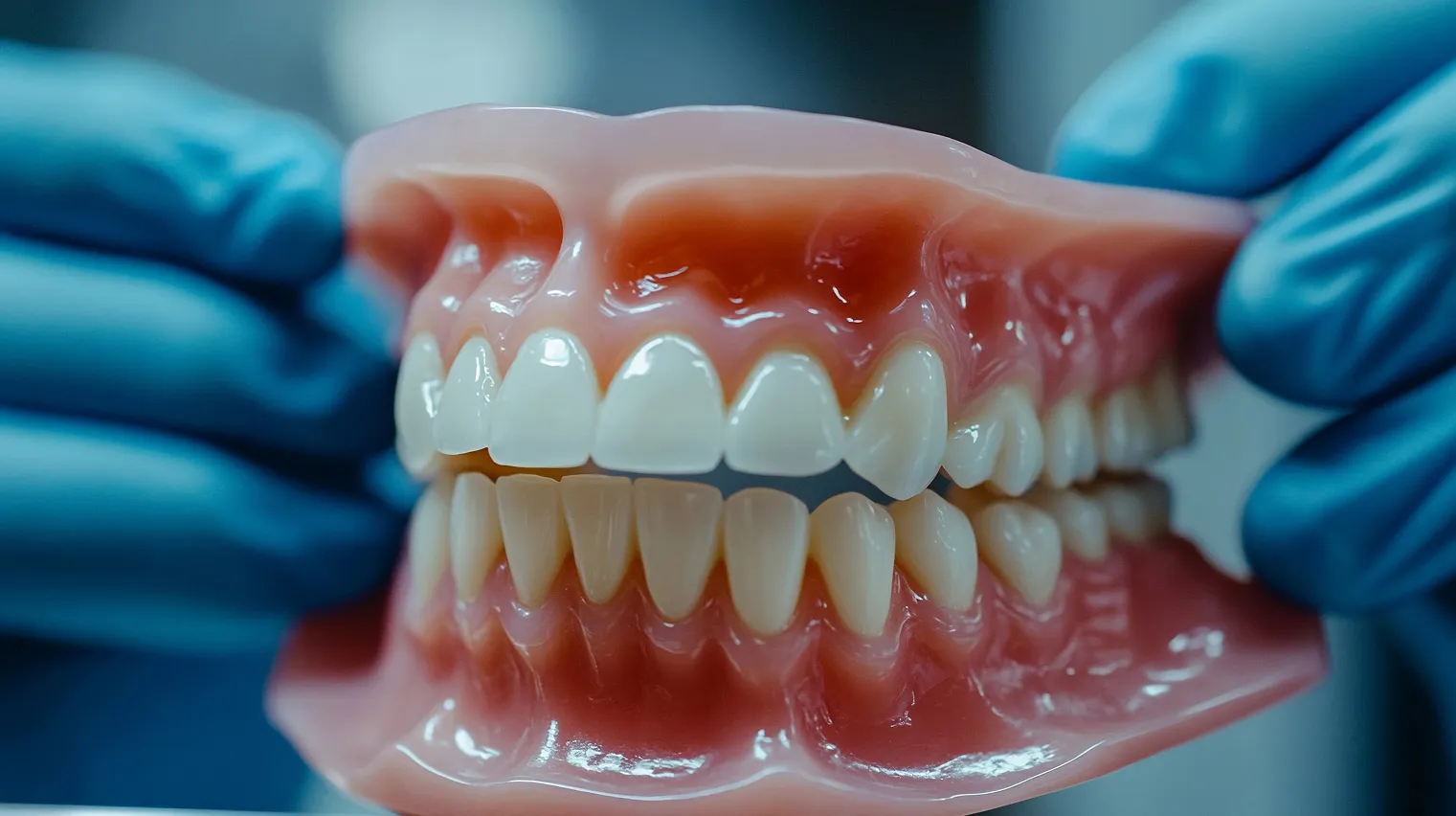
Removable work, made for the mouth it goes into
- Covers
- Full, partial, combined
- Type
- Removable and combined
- Held by
- Clasps, crowns or a bar
- Made by
- Dental laboratory
- Price
- Personal quote at your free consultation
Three ways to replace teeth you can take out to clean
Which one suits you is decided by what is left in your mouth, not by preference. The three differ in how they are held, how much of the palate they cover and how stable they feel, and those differences are worth understanding before you choose.
Full removable denture
For a patient who has lost all their teeth and whose bone structure does not allow implants. It rests on the gum and jaw ridge, replaces a whole arch, and for many patients it is the solution that gives daily life back: eating, speaking and appearing in company without thinking about it.
Partial cast-clasp denture
A cast-clasp denture is a partial denture held in place by metal clasps that grip your own remaining teeth. It is the answer for a patient who still has some teeth of their own, where those teeth are not suitable for carrying a crown or a bridge. The clasp denture comes out to be cleaned, and the teeth it grips take some of the load every time you chew, which is why they are looked after carefully afterwards.
The gold-clasp version
The clinic also makes partial dentures with gold clasps. Gold has an antibacterial effect and is kinder to the joint. It also holds its material value, so it can be recycled later. It costs more than the standard cast alloy.
Combined work, with nothing on show holding it in
A combined restoration is a denture built in two halves: a fixed part, a crown or a bridge cemented onto your own prepared teeth, and a removable part that clips onto it by a hidden attachment. It is the most stable of the three and the most comfortable to wear, because the metal connector is far thinner and does not cover the whole palate. The join between the two halves sits out of sight, so what other people see is teeth rather than hardware. That is the difference most patients notice first when they move across from a denture held by visible clasps.
Five ways of attaching it
The removable part can be held on in five ways, and these are the names you may meet on a quote from any clinic. Clasps grip the teeth that are still there. A telescopic crown is a crown fixed permanently over your own tooth, with the denture clipping down over the top of it. Micro-anchoring uses a small hidden sliding attachment that the denture pushes onto. An MK1 is an attachment that locks on one side only. A bar is a metal rail fixed across the mouth between two supports, with the denture clipping onto the rail, and it is most often used with implants. Which of the five is possible depends on the teeth you still have.
A denture is usually the question when
- you have lost all the teeth in one jaw or in both
- some teeth remain, but not enough or not sound enough to carry a bridge
- the bone will not support implants, or you would rather not have surgery
- an existing denture has become loose, sore or uncomfortable to eat with
- the clasps on your current denture are visible when you speak
- you want the gap closed but need the cost spread over something simpler
How it is made
From the first examination to the day you wear it
A denture is made in stages, each one building on the last, with laboratory work in between. The sequence below is the general path; how many appointments your own case takes is set out in your plan before anything starts.
- 01
Examination and plan
We look at what is left: which teeth remain, whether they are sound enough to hold anything, and what the gum and jaw ridge underneath are like. That decides which of the three types is realistic, and you are told why.
- 02
Preparing the mouth
Teeth that cannot be saved come out and are given time to heal. Teeth that will carry the denture may need fillings, root canal treatment or crowns first, since anything the prosthesis relies on has to be sound before it takes the load.
- 03
Impressions
Impressions are taken of the arch so the laboratory has the exact shape of the ridge, the palate and the remaining teeth. For combined work the fixed part is prepared and captured at this stage too.
- 04
Bite registration
The way your jaws meet is recorded, so the new teeth are set at the height and position your face and joint are used to. Get this stage wrong and a denture can fit the ridge perfectly and still feel wrong to wear.
- 05
Try-in
The teeth are set in wax and tried in your mouth before anything is finished. You see the shape, the shade and the position and say what you think, and changes at this point cost nothing but an appointment.
- 06
Fitting
The finished denture is fitted, the bite is checked and pressure points are adjusted. For combined work the fixed part is cemented and the removable part is seated onto its attachments.
- 07
Settling in and review
New dentures are reviewed after a short period of wear, because a sore spot is normal in the first days and easily relieved. Bring the denture in to have it eased rather than filing it down at home. Gums and bone keep changing shape over the years, so a denture is relined or adjusted at intervals.
Your remaining teeth still need looking after once a denture is in. A partial or combined denture depends entirely on the teeth holding it, and those teeth are the first thing to be lost if hygiene appointments stop.
The three types
What actually differs between them
Stability, palate coverage and cost move together, and so does what your mouth has to offer in the first place. Read the last row with the second one: a combined restoration is only possible if there are teeth sound enough to carry the fixed part.
Suits
- Full removable denture
- A jaw with no teeth left, where implants are not possible
- Partial cast-clasp denture
- Some own teeth remaining, not suitable for a crown or bridge
- Combined restoration
- Some own teeth remaining that are sound enough to carry a crown or bridge
What holds it in
- Full removable denture
- The gum and jaw ridge it rests on
- Partial cast-clasp denture
- Cast clasps gripping the remaining teeth
- Combined restoration
- An attachment joining it to a fixed crown or bridge
Palate coverage
- Full removable denture
- The full palate, which is what gives it its hold
- Partial cast-clasp denture
- A cast metal framework across part of the palate
- Combined restoration
- A much thinner connector that does not cover the whole palate
Stability
- Full removable denture
- The least stable of the three
- Partial cast-clasp denture
- More stable, though the clasps take the strain
- Combined restoration
- The most stable; the removable part comes out only for cleaning
Visible metal
- Full removable denture
- None
- Partial cast-clasp denture
- Clasps can show, depending on which teeth hold it
- Combined restoration
- The connection is not visible
Cost bracket
- Full removable denture
- The most economical of the three
- Partial cast-clasp denture
- In between; gold clasps add to it
- Combined restoration
- The highest, because laboratory-made fixed work is part of it
Getting used to it
- Full removable denture
- The longest adjustment, particularly for speech and taste
- Partial cast-clasp denture
- Straightforward for most patients
- Combined restoration
- Easy to get used to, and safe in daily wear
The gold-clasp option belongs to the middle column: a partial denture can have its clasps cast in gold instead of the standard alloy, at a higher price.
Removable or fixed
How a denture compares with implant-supported work
Both routes replace missing teeth and neither is automatically the right answer. What follows is the honest trade, so you can weigh it before anyone quotes you for either.
Surgery
- Removable denture
- None
- Implant-supported
- Implants are placed surgically under local anaesthetic
What the jaw needs to offer
- Removable denture
- A ridge to rest on, or teeth to clasp
- Implant-supported
- Enough bone, or bone grafting first
Time to complete
- Removable denture
- Weeks, set by laboratory stages
- Implant-supported
- Months, because the implant has to fuse with the bone first
Day to day
- Removable denture
- Taken out for cleaning; may need relining as the ridge changes
- Implant-supported
- Cleaned in the mouth, or removed only for cleaning on a bar or locator
Effect on the jaw
- Removable denture
- Rests on the ridge, which continues to resorb over the years
- Implant-supported
- Loads the bone, which helps preserve the ridge
Cost
- Removable denture
- The lower outlay, and the shorter route
- Implant-supported
- The higher outlay, quoted per implant and per piece of work on top
Where they meet
- Removable denture
- A removable denture can be held steady by implants rather than by the gum alone
- Implant-supported
- A denture that clips onto implants is stable without being a fixed arch
Implants are not a better answer for everyone, and a well-made removable denture is not a compromise for a patient whose bone or general health rules surgery out. If both are open to you, we set out both, and you are given the cost of each.
What it costs
What a denture costs here
The three types sit in genuinely different brackets, and the gap between them is mostly laboratory work. What your own case costs depends on what has to happen in your mouth before the denture is made at all.
What decides the figure
- Which type your mouth allows
- A full removable denture, a partial clasp denture and a combined denture are three different amounts of work, and they are priced accordingly.
- Preparation before it is made
- Extractions, fillings, root canal treatment or crowns on the teeth that will carry the denture are quoted separately, because not every patient needs them.
- The attachment system
- The five ways of clipping the removable part onto the fixed part are not interchangeable in cost, and the choice is clinical before it is financial.
- Materials
- Gold clasps cost more than the standard cast alloy. The gold holds its material value and can be recycled later, which is part of the picture.
- Laboratory stages
- Every appointment where something is impressed, registered or tried in has laboratory work attached to it. More stages, more cost.
How you get a price
- 01Free consultationThe clinic's personal assessment costs nothing. We look at the tooth, review any imaging your case needs and explain what the options actually involve.
- 02A cost estimate before anything is scheduledYou are quoted for your own mouth, for the materials your case needs and the number of appointments it takes, rather than handed a table average that may not apply to you.
- 03You decide afterwardsThere is no obligation to book treatment after the consultation. If you are comparing clinics, take the estimate home with you.
Most of our patients travel from Austria and Germany. In the clinic's experience, treatment here costs on average 15 to 20 percent less than comparable private care in Austria. Your own figure depends on your treatment plan, and you will have it in writing before anything is booked.
The figures on this page and on the price list are indicative and show what treatment starts from. Your own amount comes from your examination and is given to you in writing before anything is booked. The examination is free.
Dentures, answered
Will the clasps show when I smile?
On a partial denture held by clasps they can, depending on which teeth are holding it and how high you smile. It is the usual reason patients ask about combined work instead: there the removable part is joined to a fixed crown or bridge by an attachment that sits out of sight, so nothing metal appears at the front. We will show you where the clasps would sit before you decide.
Does a full denture have to cover the palate?
In the upper jaw, yes. Coverage of the palate is a large part of what holds a full upper denture in place, since there are no teeth left to grip. That is also why patients notice a change in how food tastes at first. Combined work, or a denture held by implants, is the way round it, and both need something in the mouth to hold on to.
How long does it take to get used to a new denture?
Expect a settling-in period. Speech and eating both take practice, particularly with a full upper denture. Small sore spots in the first days are normal: a new denture presses hardest on one small patch of gum, that patch goes tender, and it is relieved at a review appointment by easing the fitting surface at exactly that point. Combined work is generally easier to get used to, because it is more stable and covers less of the palate.
Can I eat normally with a denture?
Most things, yes, and the more stable the denture the shorter the list of exceptions. Start with softer food cut small, chew evenly on both sides, and give it time. If a denture still moves when you eat once the settling-in period is over, bring it back in to be adjusted or relined.
How do I clean a denture, and the teeth holding it?
Clean the denture out of the mouth, over a basin of water so a drop does not break it, with a brush and a cleaner meant for dentures. Ordinary toothpaste is too abrasive for the material. Your own remaining teeth and gums are then brushed separately, and the teeth carrying a partial or combined denture need the most care of all: the place where a denture meets a tooth is exactly where deposits gather. That is also why clasped and combined work needs professional hygiene appointments.
Where is the denture actually made?
In the clinic's own dental laboratory, in the same building. The work is not sent out to a firm somewhere else, which matters most at the try-in: when something needs easing or reshaping, it goes to the technician who made it rather than back into a courier van.
Is there a guarantee on the work?
Five years, on the dental work and on everything the laboratory makes for you, dentures, crowns and bridges alike. The condition is that you come to the clinic for a check-up every six months. That condition is not a formality. A denture rests on gum and bone that keep changing shape, and the half-yearly appointment is when a small problem is relined away instead of becoming a remake.
Will it need adjusting later?
Yes, at intervals. The gum and bone under a denture keep changing shape after teeth are lost, so a denture that fitted well when it was made can loosen over the years. Relining rebuilds the fitting surface against the ridge as it is now, so the same denture fits the mouth as it has become. It is routine maintenance, not a sign that anything was made badly, and it is the usual answer when a comfortable denture starts to move or to rub.
Before you decide
Find out which type your mouth actually allows.
Bring us the gap, or the denture that has stopped fitting. We will look at what is left, explain which options are realistic and quote each one, with nothing booked until you have had time to think.
Or call the clinic+36 (99) 50 60 90